

Earth ‘rocked’ by KILOMETRE-wide asteroid 12,000 years ago – leaving 19-mile crater only just uncovered
Scientists made a surprise discovery of an enormous crater hiding beneath Greenland's ice sheets

AN ENORMOUS crater that measures 31 kilometres across has been discovered in Greenland – hidden under an ice sheet.
Experts believe it was created by an asteroid that "rocked the Northern Hemisphere" after smashing into Earth as recently as 12,000 years ago.


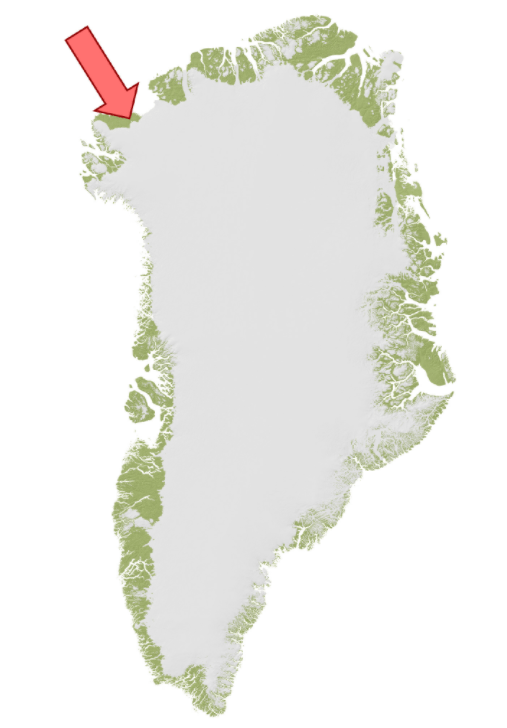
The crater was actually first detected in July 2015, but only now have scientists been able to verify the discovery.
It's the first time that a crater of any size has been found under a continental ice sheet.
The enormous cavity is bigger than London, and ranks among the 25 largest impact craters on Earth.
Scientists say that the crater was formed after a kilometre-wide meteorite hit northern Greenland.


How old is the crater?
It's believed that the crater was created at some point after ice began to cover Greenland.
This dates it from anywhere between 3million years old as 12,000 years old – "towards the end of the last ice age," according to study lead author Professor Kurt H. Kjær, of the Natural History Museum of Denmark, in the journal Science Advances.
"The crater is exceptionally well-preserved, and that is surprising, because glacier ice is an incredibly efficient erosive agent that would have quickly removed traces of the impact," he explained.
"But that means the crater must be rather young from a geological perspective."
Uncovering the hidden crater – how did they do it?
So how did researchers spot the crater if it was hidden beneath half-a-mile-thick ice?
While studying a map of the topography beneath Greenland's ice sheet, experts discovered a circular "depression" under the Hiawatha Glacier.
The crater was positioned at the very edge of the ice sheet, in the arctic nation's deep north.
"We immediately knew this was something special, but at the same time it became clear that it would be difficult to confirm the origin of the depression," said Professor Kjær.
Suspecting that an asteroid might be responsible for the crater, researchers concocted a plan of action.
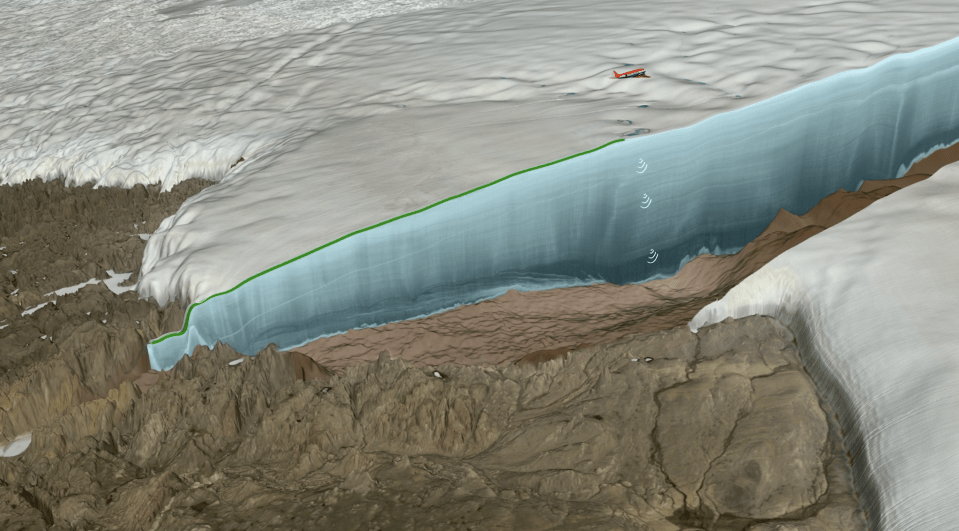
A German research plane was tasked with flying over the Hiawatha Glacier, mapping the crater and its ice with an "ice radar".
"Previous radar measurements of Hiawatha Glacier were part of a long-term NASA effort to map Greenland's changing ice cover," explained Joseph MacGregor, a Nasa glaciologist who helped with the study.
"What we really needed to test our hypothesis was a dense and focused radar survey there.
"Our colleagues at the Alfred Wegener Institute and University of Kansas did exactly that with a next-generation radar system that exceeded all expectations and imaged the depression in stunning detail.
"A distinctly circular rim, central uplift, disturbed and undisturbed ice layering, and basal debris. It's all there."

Is there proof of an asteroid impact?
During the summers of 2016 and 2017, researchers returned to the site to map rock structures.
They also collected samples of sediments that had been washed out of the crater through a channel of icy meltwater.
This helped the experts make an important discovery.
"Some of the quartz sand washed from the crater had planar deformation features indicative of a violent impact," said Professor Nicolaj K. Larsen, of Aarhus University.
"This is conclusive evidence that the depression beneath the Hiawatha Glacier is a meteorite crater."

What's the difference between an asteroid, meteor and comet?
Here's what you need to know, according to Nasa...
- Asteroid: An asteroid is a small rocky body that orbits the Sun. Most are found in the asteroid belt (between Mars and Jupiter) but they can be found anywhere (including in a path that can impact Earth)
- Meteoroid: When two asteroids hit each other, the small chunks that break off are called meteoroids
- Meteor: If a meteoroid enters the Earth's atmosphere, it begins to vapourise and then becomes a meteor. On Earth, it'll look like a streak of light in the sky, because the rock is burning up
- Meteorite: If a meteoroid doesn't vapourise completely and survives the trip through Earth's atmosphere, it can land on the Earth. At that point, it becomes a meteorite
- Comet: Like asteroids, a comet orbits the Sun. However rather than being made mostly of rock, a comet contains lots of ice and gas, which can result in amazing tails forming behind them (thanks to the ice and dust vapourising)

The University of Cardiff was also involved in analysing the materials found at the site.
"When the results came through from the chemical analysis, they were certainly unexpected," said Dr Iain McDonald, of Cardiff University.
The analysis revealed metals among the material, heavily suggesting the "presence of a meteorite".
"Initially we thought we might find the signature from a chrondritic or 'stoney' meteorite, but the only explanation for the pattern of metals that we found had to be a mixture between the crustal rocks in the surrounding area and an unusual iron asteroid," Dr McDonald added.
MOST READ IN SCIENCE


Did the asteroid impact wipe out any life?
Sadly, although there's evidence of a huge impact, it's still not clear how life on Earth would've been impacted.
Previous research shows that large asteroid impacts can significantly affect Earth's climate – and our planet's life.
Dating the impact accurately is the next step, because then scientists can investigate how local life may have been affected.
"The next step in the investigation will be to confidently date the impact," said Professor Kjær.
"This will be a challenge because it will probably require recovering material that melted during the impact from the bottom of the structure, but this is crucial if we are to understand how the Hiawatha impact affected life on Earth."
Do you think this discovery is exciting or terrifying? Let us know in the comments!
We pay for your stories! Do you have a story for The Sun Online news team? Email us at [email protected] or call 0207 782 4368 . We pay for videos too. Click here to upload yours.